Home » Archives for system



Written by Marriage and Family Therapist, Child Play Therapist, Rachel Ng
When my son was in the first grade, I often encountered the same group of parents at the pick-up and drop-off station. One of the parents had a son who coincidentally attended the same school and grade as my son, so we gradually became acquainted. It was also during that time that I began to witness what was called “monster parents”!
She would frequently ask about my child’s extracurricular activities because her son was enrolled in various classes every day, sometimes even attending two in a single day. On the other hand, I struggled to list many activities for my son. He enjoyed exploring and creating games at home, finding his own joy. I also saw that he was able to grasp the lessons taught at school, so I felt that there was no need for him to participate in additional extracurricular activities. Always, my wish for him was to be happy.
However, gradually, when most of the parents around you gather and chatter about what their children are learning, what levels they’ve achieved in music and language exams, and so on, I, who originally believed in the “go with the flow” approach, began to feel anxious. I couldn’t help but question whether I was a lazy, unambitious, and neglectful mother who didn’t plan for her child’s future!
And so, I also began to enroll my child in various courses, but the resistance I encountered was beyond what I had ever imagined. During the years from my son’s second to fourth grade, even though the number of courses he attended was not extensive, conflicts often arose between mother and son due to the insistence on him participating in additional extracurricular activities. I couldn’t bear to see both of us suffer from the results of these clashes, so I asked myself: “What is truly important for a child? To possess a wealth of knowledge but carry an unhappy heart, or to have a lively, cheerful, and positively charged life?” Even though I hadn’t yet studied marriage and family therapy at that time, I still believed that a harmonious family relationship was the cornerstone for a child to have a healthy life.
In the end, I decided to no longer “force” my son to participate in activities he disliked. By letting go in this manner, I actually created space for him to learn to take responsibility for his own decisions. He would let me know what he wanted to learn or even if he wanted to attend Chinese tutoring at the appropriate time. These exercises in autonomy and responsibility, unwittingly, became invaluable assets for my son in the future. They proved beneficial in his education and career, leading to success in every aspect.
In reality, many parents, like myself back then, find themselves in an environment of intense competition, where they see other mothers doing the same crazy things. This makes those actions seem not crazy, but rather the norm. Even if reluctantly, they feel compelled to do the same. However, children find various ways to express to us that they are struggling, that they cannot accept it! The question is, do mothers really see it? If parents have a short-sighted perspective and are anxious only about gaining an initial advantage, focusing solely on creating fleeting competitive edges for their children while neglecting to establish qualities that contribute to their long-term development, then in the end, the casualties may extend beyond just the mother-child relationship to include the child’s life itself!


Written by: Registered Nutritionist (Public Health) (UK), Ng Pui Yu
Many families choose to consume organic foods such as fruits, vegetables, and eggs. When asked about the reasons for purchasing organic food, most people respond with, “Because organic food is safer and more nutritious.” In this issue, the author will educate everyone about what organic farming is.
What is organic farming?
Organic farming refers to agricultural practices that replace synthetic substances with methods involving agriculture, biology, or machinery. It avoids using chemical fertilizers, pesticides, or genetically modified crops and instead relies on local natural resources while adhering to the laws of natural ecology. The scope of considerations is broad, for example: an organic production area on a farm must be at least 2 meters away from non-organic areas to prevent crop contamination.
Crop and Variety Selection and Diversity:
l Seeds or propagating material used for organic cultivation should be certified as organic.
l Farms must practice crop rotation and intercropping while striving for diversification to avoid monoculture.
Nutrient Management:
l Fertilization should be applied appropriately to prevent nutrient excess and environmental pollution.
l The sources, quality, quantity, and application methods of fertilizers used on the farm should be ecologically benign.
l Soil fertility should be restored through fallow periods.
l The use of chemically synthesized fertilizers, human excreta, sewage sludge, and chemical waste is prohibited.
Management of Pests, Diseases, Weed, and Crop Growth:
l Implement appropriate fertilization and irrigation management.
l Utilize physical methods, including manual techniques, fencing, light, sound frequency, heat, etc.
l Plant crops that have pest control properties (including pest repellent and attracting natural enemies).
l Prohibit the use of chemically synthesized herbicides, fungicides, insecticides, and other pesticides.
From this perspective, organic farming emphasizes ecological conservation in the cultivation process. However, when it comes to nutritional value, there isn’t a significant difference between organic and non-organic foods. Furthermore, there is no evidence to suggest that children who consume organic foods are healthier or more intelligent. Of course, due to the environmental friendliness and reduced use of chemical pesticides in organic farming, I also encourage everyone to make more organic choices!
Conventional Farming vs. Organic Farming
| Conventional Farming | Organic Farming |
Safety | More commonly uses chemical pesticides and fertilizers | l Fewer chemical pesticide l Emphasizes ecological environment l Uses non-genetically modified materials |
Nutrition | No significant difference | |
Health | Also need to pay attention to the principles of a healthy diet: low fat, low sugar, and low salt. | |

Written by: Speech Therapist, Lee Wing Yan
With the advancement of technology and material abundance nowadays, it’s not hard to see that tablets are being used as “electronic pacifiers” for young children. Regardless of the occasion, whenever parents bring out this “electronic pacifier” and play YouTube videos, children sit quietly, and adults can focus on their tasks. Since tablets and smartphones can calm young children and provide educational games and videos for learning, does that mean they are quality toys?
The key to selecting “quality toys” lies in whether young children can genuinely learn from them. Indeed, educational videos and interactive games can offer the cognitive concepts that preschoolers need to learn, but we also need to consider how preschoolers actually learn language.
Recent foreign research explores the impact of the parent-child interaction pattern on language development one year later (i.e., at age 3). The study found that the presence of “connectedness” between parents and children during interactions most influenced the child’s subsequent language development, including whether both parties participated in the same activity in turns. Additionally, children’s learning of verbs, such as “I eat” in “eat” or “Mom drinks water” in “drink,” directly affects their future language development (from the three examples above, it’s clear that to form complete sentences, children need to recognize a certain number of verbs).
Seizing everyday life opportunities to teach verbs through activities
So, can tablets and smartphones achieve the mentioned “connectedness”? Based on my daily observations, children tend to use tablets and smartphones alone, and they resist it when parents want to intervene. Furthermore, most of what children learn from videos are limited to English alphabets, counting, nursery rhymes, cartoon character names, or specific dialogues from cartoon characters. But what about verbs? Verbs are often easily overlooked in videos because children can learn them more effectively by doing them in real situations! For example, teaching a child the action of “brushing teeth” doesn’t it involve singing a nursery rhyme “Up and down the brush,” repeatedly emphasizing the action of “brushing,” and brushing teeth together with them? In daily life, whether during bath time, cooking, playing with toys, or going to the park, parents can take the opportunity to teach relevant verbs used in different scenarios through interactive activities.
Furthermore, research also indicates that the quality of interaction between parents and young children during play and reading, including the vocabulary adults input to children and the spontaneous “baby talk” from children, is higher compared to when using tablets and smartphones. Scholars generally believe that young children’s language learning primarily occurs through interaction with people. Therefore, if young children excessively use tablets and smartphones, reducing interaction with family members, it may be detrimental to their language development.
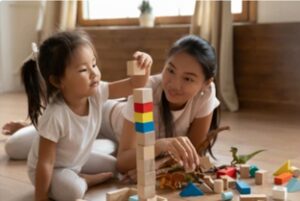
So, what defines a “quality toy”? Whether it’s choosing tablets, smartphones, or traditional toys like dolls, puzzles, and toy cars, the most important aspect to consider is:
Does it promote interaction and communication between parents and children?
Does it replace original opportunities for parent-child interaction?
In parent-child interaction and communication, parents can use various communication techniques to enrich the child’s language environment. These techniques have been mentioned in the previous article on “Four Communication Styles.” Toys are, in fact, just tools. Through toys and quality interaction, we aim to enhance young children’s language development.


Written by: Founder of Parent-Child Classroom and Senior Psychological Counselor, Ms. Leung Hung Yuk
A lady said, “You’re truly enviable – your husband is even afraid of you!” Upon hearing this remark from her friend, she playfully responded, “If you want your husband to fear you, just pretend to be a ghost and scare him, wouldn’t that work? But do you really want to scare him like that, making him afraid of you? Do you think the marriage will become happy because of that?”
Firstly, we need to understand what makes a “happy marriage.” A marriage isn’t solely about individual happiness; a happy marriage requires three key elements: mutual acceptance, intimacy, and harmonious coexistence.
Couples’ Self-Consideration Hinders Communication
When faced with many couples seeking assistance, I find that through examining the state of their marriage and identifying the underlying issues, most couples struggle with their own “self.” Personal traits can also contribute to problems that obstruct communication. Many women express that their husbands lack a sense of “security,” while on the other hand, men often feel they are not receiving the “respect” they deserve from their wives.
In fact, the happiness of a marriage is closely related to the feelings, reactions, and behavioral feedback of the two individuals involved. This is due to the fact that both people’s existing beliefs and thoughts have an impact. When entering into marriage, it’s necessary to adjust one’s mindset and beliefs first in order to approach various issues in the marriage with a positive attitude.
Considering Each Other’s Situations and Reflecting on Oneself
Once, while I was working outside and returned home late, I intended to just find any restaurant to have a meal due to the late hour. However, my husband and son had visited several restaurants and still hadn’t made a decision. I expressed my displeasure to my husband, and when he saw my expression turn sour, he naturally responded with silence in return. As a result, during that dinner, we all ate silently on our own. I felt my husband’s reaction was somewhat petty, which left me feeling unsatisfied and irritated.
The next morning, upon reflection, I pondered on my husband’s perspective. What did he need in that situation? Lately, he had been under a lot of work stress, which had worn down his patience and tolerance. Faced with my unresponsive reaction, he naturally felt uncomfortable. So, I decided to send him an email expressing my concern.
In a marriage, which couple has never had conflicts? The existence of problems between spouses is not important; what truly matters is how you handle those problems. When you’re willing to introspect and examine yourself, and when you expand beyond your own feelings, you’ll discover the needs of those around you and your partner.
The “Fresh-Keeping Method for a Happy Marriage” is about both “you” and “me” being happy. When you’re willing to embrace your partner’s weaknesses and positively accept your spouse, it naturally brings you closer and enhances the resilience of the marriage.
Discussion: Could you share your experiences in dealing with your spouse?

Written by: Education expert, Principal Cheung Jok Fong
Have you ever heard the theme song of a certain TV drama called “Embrace Love”? I really like a few lines from it, as these few words capture the essence of “family.” A family is a place that provides shelter from the wind and rain, your “support.” When you’re feeling “weary,” the door of your home will always be open for you. The mentioned “love” refers to the deep-rooted bond of kinship that’s destined from the moment you were born, stronger than blood. Indeed, what could be more important than family ties? When you’re feeling down, your family will share your burdens, willing to listen to your worries and accompany you through difficulties. When you’re sick, your family will take care of you unconditionally. When you achieve success in your studies or career, they’ll genuinely rejoice and take pride in your accomplishments. This kind of “love” can’t be bought with money.
We all hope that parents and students understand the value of family love. Sadly, this love might come too easily, acquired from birth, and as a result, some don’t fully appreciate it. Sometimes, we see in newspapers that some teenagers would rather linger on the streets than go home; some families argue all day long, turning the home into a battlefield; some even resort to violence over trivial matters, leading to tragedies. The examples mentioned are just the tip of the iceberg, and sometimes I can’t help but feel saddened that a once peaceful home can turn into such a situation.
The Three Sentences of Family Life
How can we build a harmonious family? Pope Francis once proposed the “Three Languages of Family Life” when talking about family, which are the three phrases that should be spoken more at home: “Thank you,” “Please,” and “I’m sorry.”
“Thank you” represents gratitude towards family members. Many times, children are taken care of by their parents from a young age, and they may start to take it for granted. Consider this: do parents have to prepare three meals a day for you? Who washes your clothes and cleans your shoes and socks, providing you with a cleaner living environment? When you’re sick, who takes care of you tirelessly, even getting up at night to give you medicine? Classmates, while your parents are taking care of you, why not say “thank you” more often and help with household chores when you have the time, sharing the workload with them? In fact, when children complete household tasks for their parents, parents can also say “thank you” to them. In today’s society, the notion of elders being on a pedestal is no longer appropriate. You should know that in building a harmonious family, everyone has a responsibility. Don’t think that certain tasks are necessarily assigned to specific family members. Even when you receive help from others, even family members, you can still say “thank you.”

“May I ask” represents respect for family members and polite behavior towards others. Some may think that since we are family, there’s no need to be overly polite in our speech and we can just speak straightforwardly. However, “May I ask” doesn’t just encourage us to speak politely; it reminds us to consider the feelings of our family members in our words. Sometimes, people tend to get heated over trivial matters and believe that they should argue their point forcefully in all situations, even with their family members. But is it really worth it to act this way? As the saying goes, “Winning an argument but losing the family.” Even with close family members, it’s better to choose our words carefully.
As for “I’m sorry,” it represents
seeking forgiveness from family members. When you make a mistake, it’s only
natural to have the courage to take responsibility and say “I’m
sorry” to the person you’ve hurt. At the same time, “I’m sorry”
also signifies an opportunity to mend relationships with family members.
Sometimes, right and wrong are not easily judged in a few words. Or perhaps,
there is no clear right or wrong, but rather differences in values among
individuals. Unfortunately, many conflicts arise from such differences. If no
one is willing to compromise, relationships can become very tense. As the
saying goes, “Give in a little, gain a lot.” Putting down your pride
doesn’t mean you’re surrendering, nor is it about compromising on the issue.
Instead, it creates a new opportunity to resolve the problem in a better way.